Battle of Somme Lochnagar Crater and the Larks Sang Again
The Lochnagar mine southward of the hamlet of La Boisselle in the Somme département was an underground explosive charge, secretly planted by the British during the First Earth War, to be set up for ane July 1916, the first mean solar day on the Somme. The mine was dug by the Tunnelling Companies of the Majestic Engineers nether a German field fortification known as Schwabenhöhe (Swabian Height).
The British named the mine subsequently Lochnagar Street, the trench from which the gallery was driven. The accuse at Lochnagar was i of 19 mines that were dug under the German lines on the British department of the Somme front, to aid the infantry accelerate at the start of the battle.
The mine was sprung at 7:28 a.yard. on one July 1916 and left a crater 98 ft (30 m) deep and 330 ft (100 m) wide, which was captured and held by British troops. The attack on either flank was defeated by German small arms and artillery burn down, except on the extreme right flank and just south of La Boisselle, due north of the Lochnagar Crater. The crater has been preserved equally a memorial and a religious service is held each 1 July.
Background [edit]
1914 [edit]
French and German military operations began on the Somme in September 1914. A German advance westwards towards Albert was stopped by the French at La Boisselle and attempts to resume offensive warfare in October failed. Both sides reduced their attacks to local operations or raids and began to fortify their remaining positions with underground works. On 18 December, the French captured the La Boisselle village cemetery at the west end of a German salient and established an advanced post only 3 grand (iii yd) from the German language forepart line. By 24 Dec, the French had forced the Germans back from the cemetery and the western area of La Boisselle but their advance was stopped a curt altitude forward at L'îlot de La Boisselle , in front end of German trenches protected by barbed wire.[i] Once the location of a farm and a small number of buildings, L'îlot became known as Granathof (German, shell farm) to the Germans and later on equally the Glory Hole to the British. On Christmas Day 1914, French engineers sank the first mine shaft at La Boisselle.[ii]
1915 [edit]

Map of chalk areas in northern French republic

Geological cross-department of the Somme battlefield
Fighting continued in no human's country at the west end of La Boisselle, where the opposing lines were 200 yd (180 g) apart, even during lulls along the rest of the Somme front. On the night of 8/9 March, a German sapper inadvertently broke into French mine gallery, which he found to take been charged with explosives; a grouping of volunteers took 45 nerve racking minutes to dismantle the charge and cut the firing cables. The French mine workings were taken over when the British moved into the Somme front.[3] George Fowke moved the 174th and 183rd Tunnelling Companies into the area, but at kickoff the British did not have plenty miners to take over the big number of French shafts; the problem was temporarily solved when the French agreed to leave their engineers at piece of work for several weeks.[4] On 24 July, 174th Tunnelling Visitor established headquarters at Bray, taking over some 66 shafts at Carnoy, Fricourt, Maricourt and La Boisselle. No homo's country merely south-due west of La Boisselle was very narrow, at i point about 50 yd (46 m) wide, and had go pockmarked past many chalk craters.[2] To provide the tunnellers needed, the British formed the 178th and 179th Tunnelling Companies in August, followed by the 185th and 252nd Tunnelling Companies in October.[4] The 181st Tunnelling Company was likewise present on the Somme.[v]
Elaborate precautions were taken to preserve secrecy, since no continuous front line trench ran through the surface area reverse the west end of La Boisselle and the British front end line. The L'îlot site was dedicated by posts most the mine shafts.[3] The hole-and-corner state of war continued with offensive mining to destroy opposing strong points and defensive mining to destroy tunnels, which were 30–120 ft (9–37 thou) long. Around La Boisselle, the Germans dug defensive transverse tunnels about 80 ft (24 m) long, parallel to the front line.[two] On 19 November, the 179th Tunnelling Company commander, Captain Henry Hance, estimated that the Germans were 15 yd (fourteen m) away and ordered the mine chamber to be loaded with 6,000 lb (3 long tons; 2,722 kg) of explosives, which was completed by midnight on 20/21 November. At i:30 a.m. the Germans blew the charge, filling the remaining British tunnels with carbon monoxide. The right and left tunnels collapsed and it was later on establish that the German explosion had detonated the British charge.[half-dozen] [a] From April 1915 to January 1916, 61 mines were sprung around Fifty'îlot , some loaded with 20,000–25,000 kg (xx–25 long tons) of explosives.[7]
Prelude [edit]
1916 [edit]

Map of the vicinity of Ovillers-La Boisselle (commune FR insee code 80615)
At the start of the Boxing of Albert (1–13 July), the name given past the British to the first two weeks of the Battle of the Somme, La Boisselle stood on the main axis of British attack. Purple Engineer tunnelling companies were to make two contributions to the Allied preparations for the boxing, by placing 19 mines of varying sizes beneath the German positions along the forepart line and by preparing a series of shallow Russian saps from the British front line into no man'due south land. The saps would be opened at Goose egg Hour and allow the infantry to attack the German positions from a comparatively short distance.[viii] At La Boisselle, four mines were prepared by the Regal Engineers, charges No 2 straight and No 5 right were planted at Fifty'îlot at the end of galleries dug from Inch Street Trench by the 179th Tunnelling Company, intended to wreck German tunnels and create crater lips to block enfilade fire forth no homo's country.[9]
The Germans in La Boisselle had fortified the cellars of the ruined houses and cratered ground in the vicinity make a direct infantry assault on the hamlet impossible. Y Sap and Lochnagar mines, named after the trenches from which they were dug, were excavated on the due north-due east and the south-eastward of La Boisselle, to assist the assault on either side of the German salient in the village (see map).[6] [two] The 185th Tunnelling Visitor started piece of work on Lochnagar on 11 November 1915. Two officers and sixteen sappers were killed on 4 February, when the Germans detonated a camouflet near the British 3-level mine system, starting from Inch Street, La Boisselle, the deepest level being just above the water table at around 100 ft (30 thou). The blasting were handed over to 179th Tunnelling Company in March 1916.[2]

Plan of the Lochnagar mine; for an aeriform view of the site with marked front lines, see here
The Lochnagar mine consisted of 2 chambers with a shared access tunnel. The shaft was sunk in the communication trench called Lochnagar Street. After the Blackness Scout had arrived at La Boisselle at the end of July 1915, many fortifications, originally dug by the French, had been given Scottish names. The Lochnagar mine probably had the first deep incline shaft, which sloped from one:2 to 1:three to a depth of about 95 ft (29 m) run across map. It was begun 300 ft (91 m) behind the British forepart line and 900 ft (270 m) away from the German language forepart line. Starting from the inclined shaft, almost 50 ft (15 grand) below basis, a gallery was driven towards the German lines.[2] For silence, the tunnellers used bayonets with spliced handles and worked barefoot on a flooring covered with sandbags. Flints were advisedly prised out of the chalk and laid on the floor; if the bayonet was manipulated 2-handed, an banana caught the dislodged material. Spoil was placed in sandbags and passed hand-by-mitt along a row of miners sitting on the floor and stored along the side of the tunnel, afterward to be used to tamp the accuse.[10]
When about 135 ft (41 one thousand) from the Schwabenhöhe , the tunnel was branched and the end of each branch was enlarged to form a chamber for the explosives, the chambers beingness about 60 ft (18 m) apart and 52 ft (16 m) deep.[2] see map. When finished, the access tunnel for the Lochnagar mine was four.5 by 2.5 ft (1.37 by 0.76 m) and had been excavated at a rate of virtually 18 in (46 cm) per twenty-four hour period, until almost one,030 ft (310 m) long, with the galleries ending beneath the Schwabenhöhe . The mine was loaded with 60,000 lb (27 long tons; 27,000 kg) of ammonal in two charges of 36,000 lb (sixteen long tons; 16,000 kg) and 24,000 lb (eleven long tons; 11,000 kg).[10] As the chambers were non big plenty to hold all the explosive, the tunnels that branched to course the 'Y' were also filled with ammonal. Ane co-operative was 60 ft (18 chiliad) long and the other 40 ft (12 1000) long. The tunnels did not quite reach the German forepart line only the boom would dislodge enough cloth to grade a 15 ft (iv.6 m) high rim and bury nearby trenches.[ii] The Lochnagar and the Y Sap mines were "overcharged" to ensure that large rims were formed from the disturbed ground.[2] Communication tunnels were as well dug for use immediately after the outset attack, including a tunnel across no man'south land to a betoken close to the Lochnagar mine, ready to extend to the crater after the detonation as a covered route.[2] [xi] The mines were laid without interference by German language miners but as the explosives were placed, German miners could exist heard beneath Lochnagar and above the Y Sap mine.[10]
An officer wrote
At ane place in particular our men swore they thought he [the High german enemy] was coming through, and so we stopped driving forward and commenced to bedroom in double shifts. We did not expect to complete information technology earlier he blew, but we did. A bedchamber 12' × six' × 6' in 24 hours. The Germans worked for a shift more we did and then stopped. They knew we had chambered and were afraid we should blow and no more work was washed there. I used to hate going to listen in that bedchamber more than than any other place in the mine. Half an hour, sometimes one time sometimes three times a twenty-four hours, in mortiferous silence with the geophone to your ears, wondering whether the sound you heard was the Boche working silently or your ain heart beating. God knows how we kept our nerves and sentence. After the Somme attack when we surveyed the German mines and connected up to our own system, with the theodolite we found that nosotros were five feet apart, and that he had only started his sleeping accommodation and so stopped.
—Helm Stanley Bullock, 179th Tunnelling Company[half-dozen]
Boxing [edit]
1 July [edit]

34th Partition attack at La Boisselle, ane July 1916
The 4 mines at La Boisselle were detonated at 7:28 a.yard. on ane July 1916, the first solar day on the Somme. The explosion of the Lochnagar mine was initiated by Captain James Young of the 179th Tunnelling Visitor, who pressed the switches and observed that the firing had been successful.[two] The two charges of the Lochnagar mine created a single, vast, shine sided, flat lesser crater measuring some 220 feet (67 metres) bore excluding the lip, and 450 feet (137 metres) across the full extent of the lip. It had obliterated between 300 and 400 feet (91 and 122 metres) of the High german dug-outs, all said to have been full of German troops.[2] The Lochnagar mine, along with Y Sap mine, were the largest mines always detonated.[12] The sound of the blast was considered the loudest human being-made racket in history upward to that signal, with reports suggesting it was heard in London.[13] They would be surpassed a year later by the mines in the Boxing of Messines. The Lochnagar mine lay on the sector assaulted by the Grimsby Chums, a Pals battalion (10th Battalion, The Lincolnshire Regiment).[12] The infantry of the British 34th Partition, which was composed of Pals battalions from the northward of England, attacked the positions on either side of La Boisselle, of Reserve Infantry Regiment 110 of the German 28th Reserve Division, mainly recruited from Baden.[14]
When the primary attack began at seven:30 a.m., the Grimsby Chums occupied the crater and began to fortify the eastern lip, which dominated the vicinity and the advance continued to the Grüne Stellung (second position), where information technology was stopped past the 4th Company, which so counter-attacked and forced the British dorsum to the crater.[14] During the solar day German artillery fired into Sausage Valley and in the afternoon began systematically to shell areas and then fire bursts of auto-gun fire to take hold of anyone who moved. High german artillery also began to bombard the crater, where wounded and lost men sought shelter, specially those from Sausage Valley to the southward of the hamlet. British artillery began to burn on the crater, which led to shell bursts on both slopes, leaving the men within with nowhere to hibernate. A British shipping flew low overhead and a soldier waved a dead man's shirt, at which the airplane flew away and the British shelling stopped.[xv]
Aeriform ascertainment [edit]
The blowing of the Y Sap and Lochnagar mines was witnessed past pilots who were flight over the battlefield to report back on British troop movements. It had been arranged that continuous overlapping patrols would wing throughout the day. 2nd Lieutenant Cecil Lewis' patrol of iii Squadron was warned confronting flying too close to La Boisselle, where two mines were due to go upward, but would be able to lookout from a safe altitude. Flying up and downwards the line in a Morane Parasol, he watched from above Thiepval, nearly two miles from La Boisselle, and after described the early morn scene in his volume Sagittarius Ascent (1936 [1977]):
We were over Thiepval and turned south to sentry the mines. As we sailed downward higher up all, came the last moment. Zippo! At Boisselle the earth heaved and flashed, a tremendous and magnificent column rose upward into the sky. In that location was an ear-splitting roar, drowning all the guns, flinging the automobile sideways in the repercussing air. The earthly column rose, college and higher to almost four grand feet. In that location it hung, or seemed to hang, for a moment in the air, like a silhouette of some great cypress tree, so fell away in a widening cone of dust and debris. A moment later on came the second mine. Again the roar, the upflung machine, the strange gaunt silhouette invading the sky. And so the dust cleared and we saw the 2 white eyes of the craters. The barrage had lifted to the second-line trenches, the infantry were over the acme, the attack had begun.
—Cecil Lewis, whose aircraft was hit past lumps of mud thrown up by the explosion.[16] [17]

Contemporary British aerial photograph showing the crater and trenches
As aircraft from 3 Squadron flew over the III Corps area, observers reported that the 34th Division had reached Peake Wood on the right flank, increasing the size of the salient which had been driven into the German lines north of Fricourt but that the villages of La Boisselle and Ovillers had not fallen. On 3 July, air observers noted flares lit in the village during the evening, which were used to plot the positions reached by British infantry.[18]
A communication tunnel was used to contact troops near the new crater and during the afternoon, troops from the ninth Cheshires of the 19th Division began to move frontward and a md was sent from the Field Ambulance during the night.[19] By 2:50 a.g. on 2 July, virtually of the 9th Cheshires had reached the crater and the German trenches adjacent, from which they repulsed several German language counter-attacks during the night and the morning.[20] On the evening of 2 July, the evacuation of wounded began and on three July, troops from the crater and the vicinity pushed forward to the south-east, occupying a small area against slight opposition.[21]
Analysis [edit]
Despite their colossal size, the Lochnagar and Y Sap mines failed sufficiently to neutralise the German defences in La Boisselle. The ruined village was meant to be captured in 20 minutes but by the end of the get-go twenty-four hours on the Somme, the Three Corps divisions had suffered more than 11,000 casualties for no result. At Mash Valley, the attackers lost five,100 men before noon and at Sausage Valley near the crater of the Lochnagar mine, there were over half dozen,000 casualties, the highest concentration on the battlefield. The 34th Division in III Corps had suffered the greatest number of casualties of the British divisions engaged on ane July.[half dozen]
Commemoration [edit]

William Orpen, an official state of war artist, saw the mine crater in 1916 while touring the Somme battleground, collecting subjects for paintings and described a wilderness of chalk dotted with shrapnel. John Masefield also visited the Somme, while preparing The One-time Front Line (1917), in which he also described the area around the crater every bit dazzlingly white and painful to await at.[22] After the war the Café de la Grande Mine was congenital nearby; later on the Second Earth State of war, many of the smaller craters were filled just the Lochnagar mine crater remained.[23] Attempts to fill it in were resisted and the land was eventually purchased by an Englishman, Richard Dunning to ensure its preservation, after he read The Old Front Line and was inspired to buy a section of the former forepart line.[24]
Dunning made more than 200 enquiries about state sales in the 1970s and was sold the crater.[24] The site had been used by cross-country motorbikes and for fly tipping just Dunning erected a memorial cross on the rim of the crater in 1986, using reclaimed timber from a Gateshead church; the cross was struck by lightning shortly after its installation and was repaired with metal banding.[25] The site attracts about 200,000 visitors a yr and there is an almanac memorial service on 1 July, to commemorate the detonation of the mine and the British, French and German war expressionless, when poppy petals are scattered into the crater.[12] [26]
Richard Dunning, possessor of the crater, was awarded an MBE in the 2022 New year's day Honours for services to Kickoff Earth State of war remembrance.[27]
Gallery [edit]
-

La Boisselle mine crater, August 1916 (IWM Q 912)
-
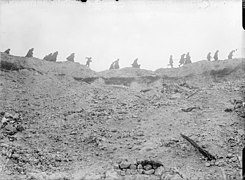
Troops passing Lochnagar Crater, October 1916 (IWM Q 1479)
-

Lochnagar Crater, La Boisselle 1984
-

Lochnagar Crater, Ovillers
-

William Orpen: Mines and the Bapaume Road, La Boisselle (Fine art.IWMART2962)
-

Orpen: The Great Mine, La Boisselle (Art.IWMART2379)
-

A Grave and a Mine Crater at La Boisselle, August 1917 (Fine art.IWMART2378)
Meet also [edit]
- List of the largest artificial non-nuclear explosions
- The Battle of the Crater from the American Civil State of war
Notes [edit]
- ^ The wrecked tunnels were gradually re-opened but nearly thirty bodies remained below La Boisselle.[6]
Footnotes [edit]
- ^ Whitehead 2013, pp. 159–174.
- ^ a b c d e f g h i j 1000 l Dunning 2015.
- ^ a b Edmonds 1993, pp. 38, 371.
- ^ a b Jones 2010, p. 114.
- ^ Fenwick 2008.
- ^ a b c d e Banning 2011.
- ^ Sheldon 2006, pp. 62–65.
- ^ Jones 2010, p. 115.
- ^ Shakespear 2001, p. 37.
- ^ a b c Edmonds 1993, p. 375.
- ^ Shakespear 2001, pp. 37, 41.
- ^ a b c Legg 2013.
- ^ Waugh 2014.
- ^ a b Whitehead 2013a, p. 297.
- ^ Middlebrook 1971, pp. 135, 218.
- ^ Lewis 1977, p. 90.
- ^ Gilbert 2007, p. 54.
- ^ Jones 2002, p. 212.
- ^ Shakespear 2001, pp. 41, 45.
- ^ Wyrall 2009, p. 41.
- ^ Shakespear 2001, p. 48.
- ^ Masefield 1917, pp. 70–73.
- ^ Gliddon 1987, pp. 255–256.
- ^ a b Skinner 2012, p. 192.
- ^ Jim Winters - The Somme Archived 26 Nov 2022 at the Wayback Machine 1st Volunteer Arms (Tynemouth) Association
- ^ Skinner 2012, p. 195.
- ^ "No. 61803". The London Gazette (Supplement). 31 December 2016. p. N17.
Bibliography [edit]
Books
- Edmonds, J. Due east. (1993) [1932]. Military Operations France and Belgium, 1916: Sir Douglas Haig's Control to the 1st July: Battle of the Somme. History of the Great War Based on Official Documents by Direction of the Historical Section of the Commission of Imperial Defence. Vol. I (Royal War Museum and Bombardment Printing ed.). London: Macmillan. ISBN978-0-89839-185-5.
- Gilbert, M. (2007). Somme: The Heroism and Horror of War . London: John Murray. ISBN978-0-7195-6890-ix – via Annal Foundation.
- Gliddon, G. (1987). When the Barrage Lifts: A Topographical History and Commentary on the Boxing of the Somme 1916. Norwich: Gliddon Books. ISBN978-0-947893-02-6.
- Jones, H. A. (2002) [1928]. The War in the Air, Existence the Story of the Part Played in the Keen War by the Imperial Air Force. Vol. Ii (Imperial War Museum and Naval & Armed services Press ed.). London: Clarendon Press. ISBN978-1-84342-413-0 . Retrieved 18 Oct 2014 – via Archive Foundation.
- Jones, Simon (2010). Underground Warfare 1914-1918. Barnsley: Pen & Sword Books. ISBN978-1-84415-962-viii.
- Lewis, C. A. (1977) [1936]. Sagittarius Rising: The Classic Account of Flying in the Outset Globe War (2nd Penguin ed.). London: Peter Davis. ISBN0-14-00-4367-5. OCLC 473683742.
- Masefield, J. (1917). The Old Front Line. New York: Macmillan. OCLC 869145562. Retrieved 19 Oct 2014 – via Archive Foundation.
- Middlebrook, M. (1971). The First 24-hour interval on the Somme. London: Penguin Books. ISBN978-0-xiv-139071-0.
- Shakespear, J. (2001) [1921]. The 30-Fourth Sectionalization, 1915–1919: The Story of its Career from Ripon to the Rhine (Naval & Military Press ed.). London: H. F. & G. Witherby. ISBN1-84342-050-3. OCLC 6148340. Retrieved xviii October 2014 – via British Library.
- Sheldon, J. (2006) [2005]. The German Regular army on the Somme 1914–1916 (Pen & Sword Military machine ed.). London: Leo Cooper. ISBN978-1-84415-269-eight.
- Skinner, J. (2012). Writing the Nighttime Side of Travel. New York: Berghahn Books. ISBN978-0-85745-341-ix . Retrieved 19 Oct 2014 – via Google Books.
- Whitehead, R. J. (2013) [2010]. The Other Side of the Wire: The Battle of the Somme. With the German Fourteen Reserve Corps, September 1914 – June 1916. Vol. I (paperback reprint ed.). Solihull: Helion. ISBN978-1-908916-89-i.
- Whitehead, R. J. (2013a). The Other Side of the Wire: The Battle of the Somme. With the German Xiv Reserve Corps, one July 1916. Vol. Two. Solihull: Helion. ISBN978-1-907677-12-0.
- Wyrall, E. (2009) [1932]. The Nineteenth Division 1914–1918 (Naval & Armed services Press ed.). London: Edward Arnold. ISBN978-one-84342-208-2.
Websites
- Banning, J. (2011). "Tunnellers". La Boisselle Report Group . Retrieved 26 June 2015.
- Dunning, R. (2015). "Military machine Mining". Lochnagar Crater . Retrieved 26 June 2018.
- Fenwick, S. C. (4 December 2008). "Corps History: Part 14 The Corps and the First Earth War (1914–18)". Imperial Engineers Museum and Library. Archived from the original on three June 2010. Retrieved 10 November 2016.
- Legg, J. (2013). "Lochnagar Mine Crater Memorial, La Boisselle, Somme Battlefields". www.greatwar.co.britain . Retrieved xviii May 2013.
- Waugh, I. (2014). "WW1 Trip to the Somme". Old British News. Archived from the original on 19 October 2014. Retrieved 19 Oct 2014.
External links [edit]
- Simon Jones, The Lochnagar Mine
- Lochnagar Crater - The Official Site
- Aerial view with front end lines
- Aerial view of Ovillers-La-Boisselle; the crater of the Lochnagar mine is visible about the lesser
- Surface model of the Y Sap, Glory Hole and Lochnagar craters
- 360° Panoramic View
- La Boisselle Study Group
- Ovillers-La-Boisselle photograph essay
- Grimsby Roll of Honour, 1914–1919
- Reid, P. Lochnagar Crater, La Boisselle
- Son of a coach mechanic preserves hallowed crater from WWI
Source: https://en.wikipedia.org/wiki/Lochnagar_mine
0 Response to "Battle of Somme Lochnagar Crater and the Larks Sang Again"
Postar um comentário