Draw Half Circle Using Css
What I hateful by "CSS images" is images that are created using just HTML elements and CSS. They look as if they were SVGs drawn in Adobe Illustrator merely they were made right in the browser. Some techniques I've seen used are tinkering with edge radii, box shadows, and sometimes clip-path. You lot can find a lot of bully examples if you lot search daily css images" on CodePen. I drew some myself, including this Infinity Gauntlet, merely in one element with simply backgrounds and minimal utilise of other properties.
Allow'southward take a look at how yous can create CSS images that way yourself.
The Method
Understanding the shorthand background syntax likewise as how CSS gradients work is practically all you demand to draw annihilation in 1 chemical element. As a review, the arguments are as follows:
background: <'background-color'> || <image> || <position> [ / <size> ]? || <repeat> || <attachment> || <origin> || <clip>; They tin can occur in any social club except that there must be a / between the position and size. We must keep those 2 arguments in that order as well, or else nosotros'll become unexpected results. Non all of these need to be included, and for this purpose we won't be using the colour, echo, attachment, origin, or clip arguments. This leaves us with image, size, and position. Since backgrounds echo by default, however, we must place groundwork-repeat: no-repeat; right under everything in background (if certain backgrounds ought to be repeat, we can use repeating-linear-gradient() and repeating-radial-gradient()). In that case, the skeleton CSS volition be this:
.paradigm { groundwork: <image> <position> / <size>; background-repeat: no-repeat; } Nosotros can even utilise multiple sets of background arguments! Therefore, we tin can stack and split them with commas like this:
.image { background: <image> <position> / <size>, <prototype> <position> / <size>, <epitome> <position> / <size>; groundwork-echo: no-repeat; } The construction in a higher place is the basis of how nosotros'll draw images—ane line per shape. Keep in mind that the rendering society is the opposite of how absolutely- or stock-still-position elements are ordered. The first i will show up on top instead of at the bottom. In other words, the circles (radial gradients) beneath would be rendered from bottom to acme (blueish on bottom, red on pinnacle).
.circles { groundwork: radial-gradient(7em 7em at 35% 35%, scarlet 50%, transparent fifty%), radial-gradient(7em 7em at fifty% 50%, aureate 50%, transparent 50%), radial-gradient(7em 7em at 65% 65%, bluish 50%, transparent l%); background-echo: no-repeat; width: 240px; acme: 240px; } 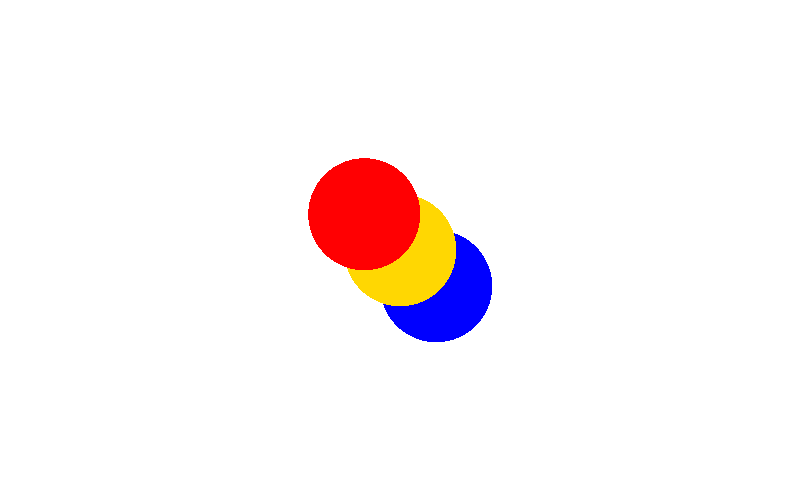
Drawing
Nosotros'll use Sass (SCSS) to draw these images so nosotros tin can brand use of variables for a color palette. That will brand the code shorter, easier to read and change darkened or lighter variants of colors. We could use variables in normal CSS instead and forget Sass, simply due to Cyberspace Explorer's lack of support, let's stick with Sass. To explain how this works, we'll experiment with shapes using both linear and radial gradients.
Setting Upwards a Color Palette
Our palette will consist of RGB or HSL colors. I'll explain after why to keep the colors in either of those formats. For this case, we'll apply RGB.
$r: rgb(255,0,0); // hsl(0,100%,l%) $o: rgb(255,128,0); // hsl(32,100%,fifty%) What I like to do to keep code brusk and easy to read is use a minimum of one letter to represent each color (eastward.m. $r for scarlet). If using darker or lighter shades of one color, I add a d earlier the base letter or messages for dark or an l for calorie-free. I'd use $dr for night cerise and $lr for light red. If in that location's a need for more two other shades, then I add a number at the end to indicate the shade level. For case, $dr1 for dark cherry-red, $dr2 for a darker scarlet, and $lr1 for calorie-free reddish, $lr2 for a lighter red. Such a palette would look like this (with dark first, normal next, and calorie-free last):
$dr1: rgb(224,0,0); $dr2: rgb(192,0,0); $r: rgb(255,0,0); $lr1: rgb(255,48,48); $lr2: rgb(255,92,92); Setting the Scale and Canvas
We'll use em units for the epitome dimensions then that the image can easily be resized proportionally. Since 1em is equal to the chemical element's font size, each unit of measurement of the image volition be adjusted accordingly if changed. Let'south set a font size of 10px and set both the width and height to 24em. Units of 10px is the easiest to think in considering if y'all mentally do the math, you lot instantly get 240 × 240px. Then just to encounter where the edges of the canvas are, we'll use a 1px gray outline.
$r: rgb(255,0,0); // hsl(0,100%,50%) $o: rgb(255,128,0); // hsl(32,100%,50%) .image { background-echo: no-repeat; font-size: 10px; outline: 1px solid #aaa; width: 24em; height: 24em; } Be mindful near using smaller font sizes, still; browsers accept a minimum font size setting (for accessiblity reasons). If y'all set a font size of 4px and the minimum is 6px, information technology'll be forced at 6px.
Furthermore, you can enable responsiveness merely by using calc() and viewport units. Perhaps we can use something like calc(10px + 2vmin) if desired, but let's stick with 10px for now.
Drawing Shapes
The fun part begins here. To draw a square that is 8 × 8em in the center, nosotros employ a linear-slope() with two aforementioned-colored stops.
.image { background: linear-gradient($r, $r) fifty% 50% / 8em 8em; ... } 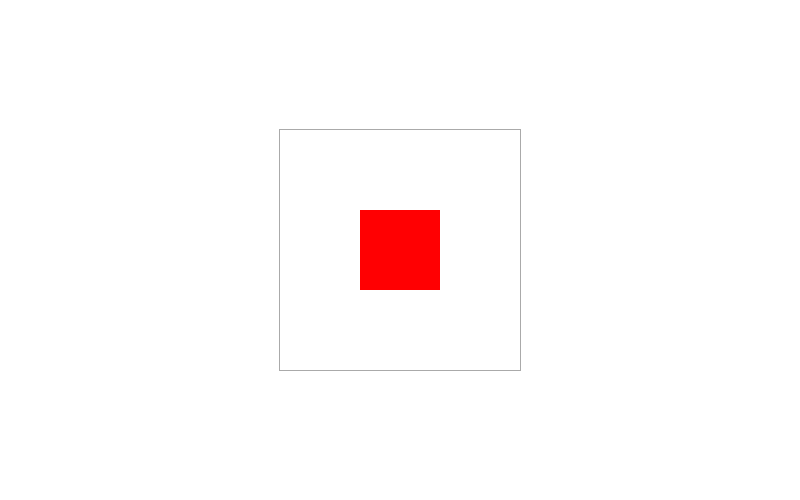
To mold it into something more similar a trapezoid, set an angle of 60deg. At the same time, let's add together $T for transparent to our palette and and so place both the stops for $r and $T at 63% (right before the bottom-correct corner gets cut off).
$T: transparent; .image { background: linear-gradient(60deg,$r 63%, $T 63%) 50% fifty% / 8em 8em; ... } 
Setting both stops at the same value makes the slanted side as well-baked as the others. If you lot look at it more closely though, it appears to be pixelated:

To right this, nosotros slightly adjust i of the stops (by 1% or roughly so) and so that the border is smooth enough. So, let'south alter $r's 63% to 62%.
This will be an issue with round edges every bit well while working with radial gradients, which nosotros'll see later. If you're viewing this in a browser other than Safari, everything looks great fifty-fifty if transitioning to a non-transparent color instead (say orange). The problem with transitioning to transparent in Safari is that you'll discover a bit of black lining at the slanted side.
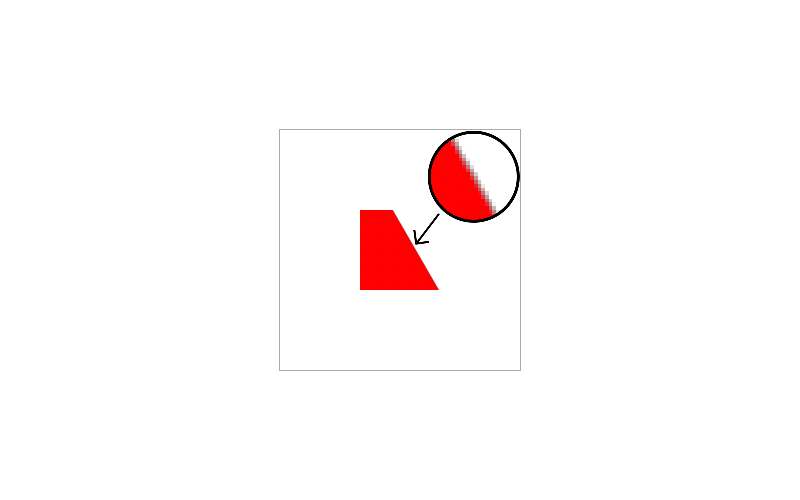
This is considering the transparent keyword in Safari is always black transparency, and we see some black as a issue. I really wish Apple would fix this, but they never will. For the time existence, let's add together a new $redT variable for red transparency nether $r. Scrap the $T nosotros used for transparent as we'll no longer utilize it.
$rT: rgba(255,0,0,0); // hsla(0,100%,50%,0) And so let's replace transparent with $redT. This takes care of our Safari problem!
.image { groundwork: linear-gradient(60deg,$r 62%, $rT 63%) 50% 50% / 8em 8em; ... } 
If you've been wondering why we weren't using hex colors, Internet Explorer and Edge don't support the #rgba and #rrggbbaa notations (yep, hex has had an alpha channel since late 2016 if you never knew), and we want this to work as cross-browser equally possible. We also want to stay consequent with our pick of color format.
At present let's motion the shape vertically to 20% and describe an orange circumvolve of the same dimensions. Also, add another variable for its transparent version. For the smooth edge, insert a i% gap betwixt the solid and transparent oranges.
$oT: rgba(255,128,0,0); // hsla(32,100%,50%,0) .image { background: linear-gradient(60deg,$r 62%, $rT 63%) 50% 20% / 8em 8em, radial-gradient(8em 8em at fifty% 80%, $o 49%, $oT fifty%); ... } 
To maintain consistency with our sizing, the second color cease should be at fifty% instead of 100%.
Positioning Shapes
The way gradients are positioned is based on whether the unit is fixed or a per centum. Suppose we plough both of the gradients into squares and try to place them all the way beyond the div horizontally.
.image { background: linear-slope($r, $r) 24em 20% / 8em 8em, linear-gradient($o, $o) 100% fourscore% / 8em 8em; ... } 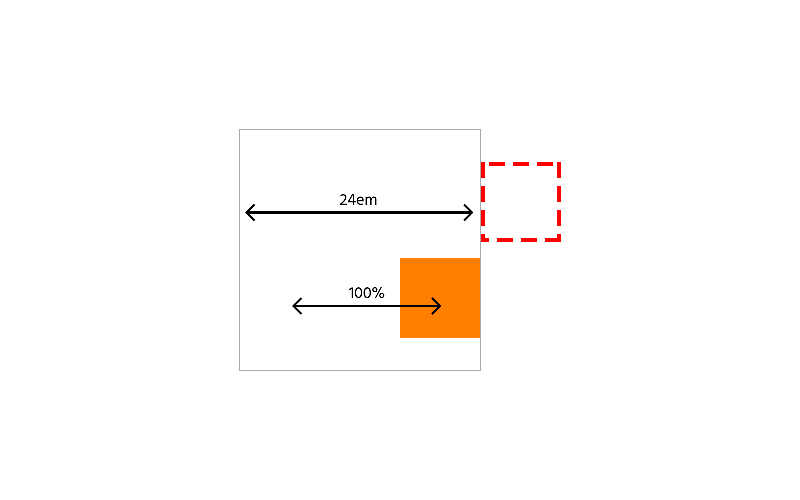
The blood-red foursquare ends upwards completely off sheet (outlined), and the right side of the orange foursquare touches the other side. Using fixed units is like placing absolutely positioned elements or cartoon shapes in HTML5 canvass. Information technology's true in that sense that the signal of origin is at the top left. When using percent and a set up background size, the div gets "fake padding" of half the background size. At the aforementioned time, the background's point of origin is centered (non to be confused with background-origin, which regards box corners).
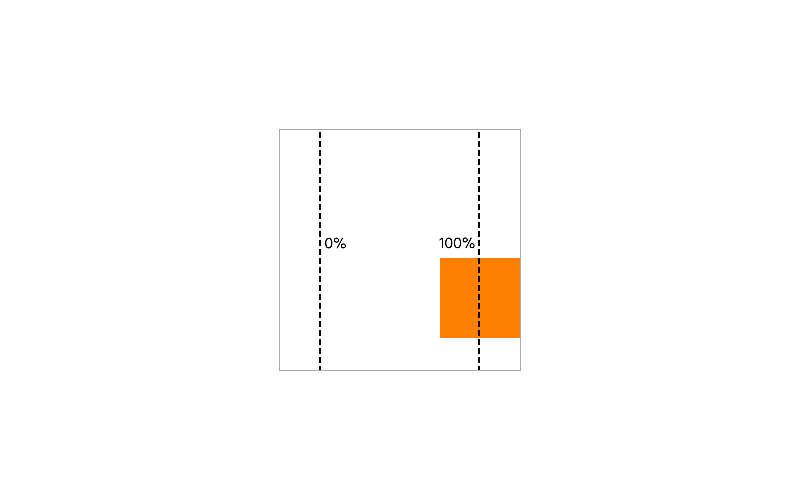
Now, if we turned these gradients into radial gradients as circles and applied the same 10-positions 24em and 100%, both end up at the other side cut in one-half. This is because the point of origin is e'er in the heart if we write the groundwork similar so:
.prototype { groundwork: radial-gradient(8em 8em at 24em 20%, $r 49%, $rT 50%), radial-gradient(8em 8em at 100% fourscore%, $o 49%, $oT 50%); ... } 
If we rewrote the background then that the position and size are afterwards the gradient and used 100% 100% at center, they'll be positioned like the linear gradients. The red ane ends up outside, and the orange one touches the right border. The "imitation padding" occurs over again with the orange.
.image { groundwork: radial-gradient(100% 100% at center, $r 49%, $rT l%) 24em 20% / 8em 8em, radial-gradient(100% 100% at centre, $o 49%, $oT 50%) 100% 80% / 8em 8em; ... } 
There's no unmarried proper style to position shapes, only to place information technology similar an admittedly or fixed positioned HTML element, use fixed units. If in demand of a quick way to place a shape (using the position / size parameters) in the expressionless center, 50% is the all-time selection equally the shape's origin volition be its center. Apply 100% if it should touch the very right side.
Sizing Shapes
Sizing in CSS backgrounds works as we'd look, simply information technology'south yet influenced past the kind of unit used for position—fixed or percent. If we accept our squares once again and change their width to 10em, the red one expands to the right, and the orange one expands sideways.
.image { groundwork: linear-gradient($r, $r) 12em twenty% / 10em 8em, linear-gradient($o, $o) 50% 80% / 10em 8em; ... } 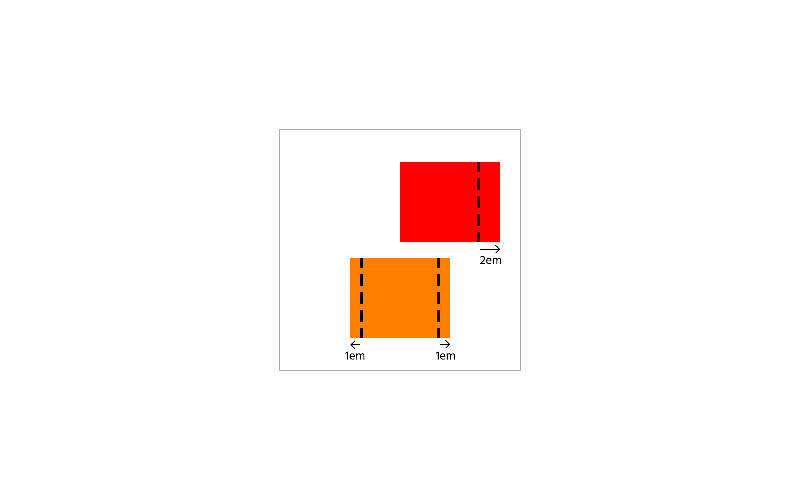
If nosotros used em units for the y-position, the shape will grow downwards or compress upwards after changing height. If we use a percentage, so it will expand both vertical directions.
A moment ago, nosotros looked at two ways to draw circles with radial gradients. The get-go style is to specify the width and elevation between the ( and at and then the position subsequently that:
.image { groundwork: radial-gradient(8em 8em at 50% fifty%, $r 49%, $rT 50%); ... } The 2d style is to use 100% 100% in the center and then requite the position and size:
.epitome { groundwork: radial-gradient(100% 100% at 50% 50%, $r 49%, $rT 50%) fifty% 50% / 8em 8em; ... } These methods both draw circles but will result in dissimilar outputs because:
- The showtime way occupies the whole div since there was no real background position or size.
- Giving a real position and size to the second sets it a bounding box. Consequently, it'll carry just like a linear gradient shape.
Suppose nosotros replaced $rT with $o. You'll run across that the orange volition encompass what was white or shapes under it (if we added any) for the first way. Using the second way, you'll easily notice the bounding box revealed past the orangish.

Additionally, the purpose of 100% 100% instead of using circumvolve or ellipse is to allow the circle to occupy whole bounding box. It even gives us consummate control over its dimensions. That way, information technology'll remain the same if you change the 50% 50% position to something else. If using one of the two keywords, the border of the circumvolve stops just nearly 71% of the way when centered and becomes more distorted if its position is adapted. For example, here'southward what happens when we alter the x-position to 0 for circle and ellipse:

In the long run, you can reimagine the syntax every bit radial-gradient(width height at x y) or radial-slope(100% 100% at x-in-bounding-box y-in-bounding-box) 10 y / width height. If you are drawing only a circle or oval, y'all can simplify the code with the beginning way. If cartoon office of a circle or role of a band, then the 2nd mode comes into play. There will be many applications of that in the examples nosotros'll create next.
Examples
Ready to describe something for real now? We'll walk through three examples step past step. The kickoff 2 volition be static—1 with lots of half-circles and the other dealing with some rounded rectangles. The last example will be smaller but focused on blitheness.
Static Paradigm
This parasol will be our first static image:

Nosotros'll employ a palette with reddish ($r and $rT), white ($west and $wT), orangish ($o and $oT), and dark orange ($do and $doT).
$r: rgb(255,40,40); $rT: rgba(255,40,40,0); $w: rgb(240,240,240); $wT: rgba(240,240,240,0); $o: rgb(255,180,70); $oT: rgba(255,180,70,0); $do: rgb(232,144,0); $doT: rgba(232,144,0,0); Permit'due south set our drawing area of 30 × 29em.
.parasol { // background to go hither groundwork-repeat: no-echo; font-size: 10px; outline: 1px solid #aaa; width: 30em; height: 29em; } Above the background-repeat, nosotros'll begin drawing the parts of the parasol. First, add the gradients that make up the pole (since neither overlap 1 another, the bottom-to-top order doesn't matter at this point):
.parasol { background: // 1 radial-gradient(200% 200% at 100% 100%, $practice 49%, $doT 50%) 14em 0 / 1em 1em, radial-slope(200% 200% at 0% 100%, $o 49%, $oT 50%) 15em 0 / 1em 1em, // 2 linear-gradient(90deg, $practise 50%, $o 50%) 14em 1em / 2em 25em, // iii radial-gradient(100% 200% at 50% 0, $oT 0.95em, $o 1em, $o 1.95em, $do 2em, $practice 2.95em, $doT 3em) 14em 26em / 6em 3em, // 4 radial-gradient(200% 200% at 100% 100%, $o 49%, $oT 50%) 18em 25em / 1em 1em, radial-gradient(200% 200% at 0% 100%, $do 49%, $doT 50%) 19em 25em / 1em 1em; ... } 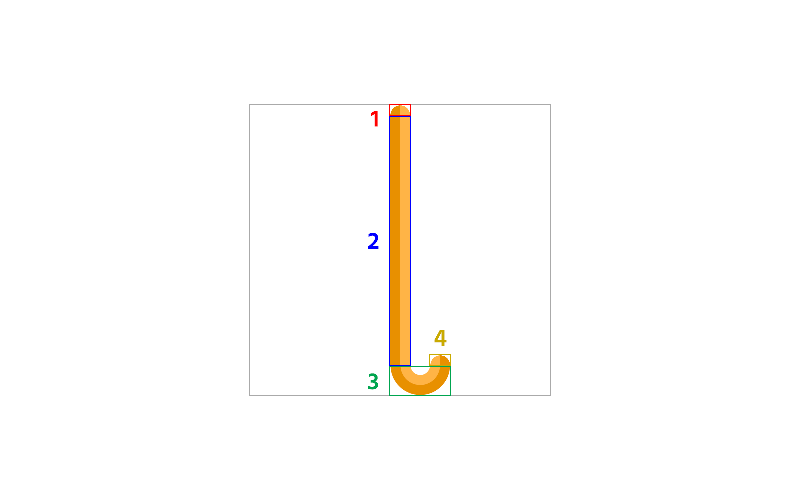
- To depict each side of the summit of the pole, we used quarters of a circle that are one × 1em. To make them occupy their bounding boxes, we used circles that are twice the size (
200% 200%) positioned at the bottom correct and at the lesser left. We could also utilize keyword pairs likeright bottomorleft bottom, simply it'south shorter to use the percent equivalents. Detect the i% gaps between the stops to ensure smoothness. - For the long part, we used a long rectangle with an abrupt dark orangish-to-orange. In that location's no need for a fractional tiny gap since we're not working with a curve or camber.
- This part of the pole is a fleck trickier to draw than the others because we have to maintain the 2em diameter. To describe this arc, we employ a box of 6 × 3em so that in that location is a 2em space between the ends that are also 2em. Then we utilize a radial gradient at the heart tiptop where each terminate occurs 1em each (and spread past 0.05em for smoothness).
- The last 2 are just like the first except they are positioned at the right end of the arc and then that they seamlessly fit. As well, the colors swap places.
Then higher up the previous gradients, add together the following from bottom to peak to draw the tiptop of the umbrella without the pointy ends:
.parasol { background: radial-gradient(100% 200% at l% 100%, $r fifty%, $rT 50.25%) 50% one.5em / 9em 12em, radial-slope(100% 200% at 50% 100%, $w 50%, $wT 50.25%) 50% 1.5em / 21em 12em, radial-gradient(100% 200% at l% 100%, $r 50%, $rT 50.25%) 50% 1.5em / 30em 12em, ... } 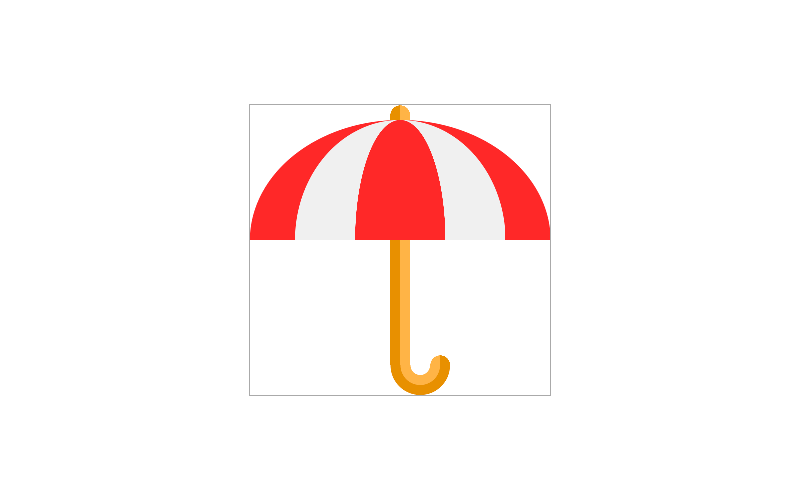
To draw the half circles that brand up this part, we used a slope size of 100% 200%, which makes each diameter fit into its background width but have twice the height and centered at the bottom. By ordering them bottom to top so that the largest is on bottom and smallest on top, we get the curves we want.
As our stack of gradients grows taller, it'll become difficult later on a while to identify which background or grouping of backgrounds corresponds to what role of the image. And so to make it easier to pin them down, we tin can split them into groups atomic number 82 by a comment describing what each grouping is for. Right now, we accept split the stack to groups for the top of the parasol and the pole.
.parasol { background: /* top */ radial-gradient(100% 200% at fifty% 100%, $r l%, $rT 50.25%) 50% 1.5em / 9em 12em, radial-gradient(100% 200% at 50% 100%, $w fifty%, $wT l.25%) l% 1.5em / 21em 12em, radial-gradient(100% 200% at l% 100%, $r 50%, $rT 50.25%) 50% 1.5em / 30em 12em, /* pole */ radial-gradient(200% 200% at 100% 100%, $practice 49%, $doT 50%) 14em 0 / 1em 1em, radial-gradient(200% 200% at 0% 100%, $o 49%, $oT l%) 15em 0 / 1em 1em, linear-gradient(90deg, $do 50%, $o 50%) 14em 1em / 2em 25em, radial-gradient(100% 200% at 50% 0, $oT 0.95em, $o 1em, $o 1.95em, $practise 2em, $exercise 2.95em, $doT 3em) 14em 26em / 6em 3em, radial-gradient(200% 200% at 100% 100%, $o 49%, $oT fifty%) 18em 25em / 1em 1em, radial-gradient(200% 200% at 0% 100%, $practise 49%, $doT 50%) 19em 25em / 1em 1em; ... } Then, in between the meridian and the pole, we'll add the adjacent chunk of backgrounds to render the pointy ends. To determine the widths of each segment, we must get the altitude between each point where ruby and white meet. They all must add up to 30em.

Starting with the white and narrowest cerise half circles, nosotros subtract the red'southward width of 9em from the white'southward width of 21em and divide the result by 2 to go the width of the two white segments (point "b" in the figure). So, the upshot would exist 6em ( b = (21 – 9) / 2 = vi ). Then the eye crimson segment would exist 9em (21 – (6 + 6) = 9). What we have left now are the outer carmine segments (point "a" in the effigy). Subtract the sum of what we take now from the width of the larger red one-half circle and split that outcome past 2. That would be make the value of point a: (30em – (half dozen + 6 + 9)) / 2 = iv.5em.
.parasol { background: ... /* pointy ends */ radial-gradient() 0 13.5em / 4.5em 3em, radial-slope() 4.5em 13.5em / 6em 3em, radial-gradient() l% 13.5em / 9em 3em, radial-slope() 19.5em 13.5em / 6em 3em, radial-gradient() 25.5em xiii.5em / 4.5em 3em, ... } To draw the half circles similar to how we drew the acme part, nosotros start with the transparent counterpart of the color for each shape so that they resemble arc bridges. We'll also add an actress five% to each gradient width (not the background box width) and then that each point formed by adjacent backgrounds won't overly precipitous and thin.
.parasol { background: ... /* pointy ends */ radial-gradient(105% 200% at fifty% 100%, $rT 49%, $r fifty%) 0 13.5em / iv.5em 3em, radial-gradient(105% 200% at 50% 100%, $wT 49%, $w 50%) 4.5em 13.5em / 6em 3em, radial-gradient(105% 200% at fifty% 100%, $rT 49%, $r 50%) l% thirteen.5em / 9em 3em, radial-slope(105% 200% at fifty% 100%, $wT 49%, $w 50%) 19.5em 13.5em / 6em 3em, radial-slope(105% 200% at l% 100%, $rT 49%, $r fifty%) 25.5em xiii.5em / 4.5em 3em, ... } 
Finally, y'all'll no longer need that 1px solid #aaa outline. Our parasol is consummate!
See the Pen Parasol past Jon Kantner (@jkantner) on CodePen.
Something With Rounded Rectangles
This next example will exist an erstwhile iPhone model in which there are more details than the newer models. The thing about this one is the two rounded rectangles, which are the exterior and middle of the home button.
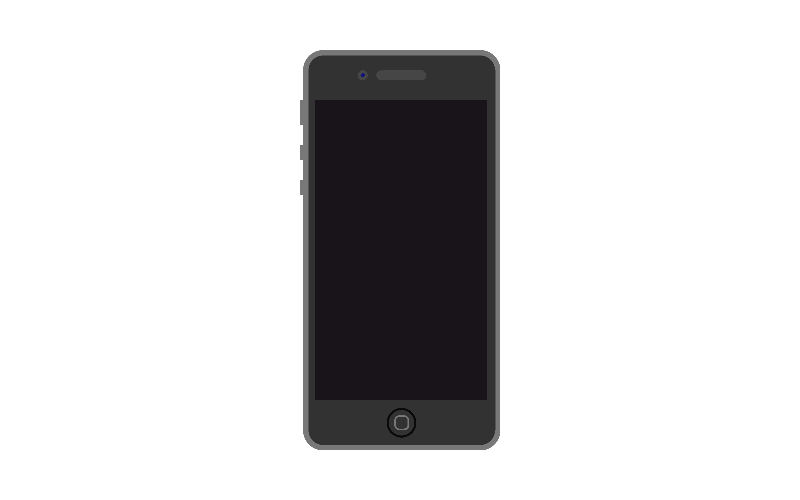
The palette volition consist of black ($bk and $bkT) for the home push button edge, night grayness ($dg and$dgT) for the body, grayness ($g and $gT) for the camera and speaker, light grayness ($lg and $lgT) for the outside border, blueish ($bl and $blT) for the camera lens, and a very dark purple ($p and $pT) for the screen.
$bk: rgb(10,10,ten); $bkT: rgba(ten,10,10,0); $dg: rgb(50,50,50); $dgT: rgba(50,50,50,0); $one thousand: rgb(lxx,seventy,70); $gT: rgba(lxx,70,70,0); $lg: rgb(120,120,120); $lgT: rgba(120,120,120,0); $bl: rgb(twenty,20,120); $blT: rgba(20,20,120,0); $p: rgb(25,20,25); $pT: rgba(25,20,25,0); Permit'due south set up our sheet at xx × 40em and use the same font size we used for the parasol, 10px:
.iphone { // background goes here background-echo: no-repeat; font-size: 10px; outline: 1px solid #aaa; width: 20em; peak: 40em; } Earlier we brainstorm cartoon our outset rounded rectangle, we demand to think about our border radius, which will be 2em. Besides, we want to leave some space at the left for the lock switch and book buttons, which will be 0.25em. For this reason, the rectangle will be nineteen.75 × 40em. Considering the 2em border radius, we'll demand 2 linear gradients intersecting each other. I must have a width of 15.75em (19.75em – 2 × 2), and the other must take a height of 36em (40em – 2 × 2). Position the first 2.25em from the left and then the second 0.25em from the left and 2em from the acme.
.iphone { groundwork: /* body */ linear-gradient() 2.25em 0 / 15.75em 40em, linear-gradient() 0.25em 2em / xix.75em 36em; ... } Since the light gray border will be 0.5em thick, allow's make each gradient stop immediately switch from light grayness ($lg) to dark gray ($dg) and vice versa at 0.5em and 0.5em before the end (40em – 0.5 = 39.5em for the first gradient, xix.75em – 0.five = nineteen.25em for the 2d). Set an bending of 90deg for the second to brand it become horizontal.
.iphone { background: /* trunk */ linear-slope($lg 0.5em, $dg 0.5em, $dg 39.5em, $lg 39.5em) two.25em 0 / 15.75em 40em, linear-gradient(90deg, $lg 0.5em, $dg 0.5em, $dg 19.25em, $lg xix.25em) 0.25em 2em / 19.75em 36em; ... } 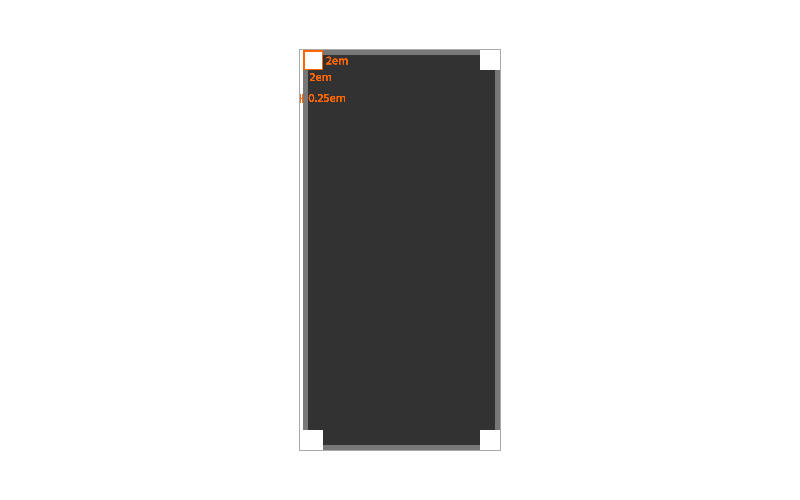
In each square corner, equally indicated by the orange box in the figure, we'll identify the rounded edges. To create those shapes, we utilise radial gradients that are twice the size of their bounding boxes and located in each corner. Insert them above the trunk backgrounds.
.iphone { groundwork: /* corners */ radial-gradient(200% 200% at 100% 100%, $dg 1.45em, $lg 1.5em, $lg 50%, $lgT 51%) 0.25em 0 / 2em 2em, radial-gradient(200% 200% at 0% 100%, $dg 1.45em, $lg 1.5em, $lg 50%, $lgT 51%) 18em 0 / 2em 2em, radial-slope(200% 200% at 100% 0%, $dg 1.45em, $lg 1.5em, $lg 50%, $lgT 51%) 0.25em 38em / 2em 2em, radial-gradient(200% 200% at 0% 0%, $dg 1.45em, $lg 1.5em, $lg 50%, $lgT 51%) 18em 38em / 2em 2em, ... } 
To get the 0.5em-thick calorie-free grayness ends, think about where the slope starts and then do the math. Because the lite gray is at the stop, we subtract 0.5em from 2em to properly place showtime stop. For the smoothness, we take off a tiny chip from the first 1.5em and add together 1% to the second 50% so that the circular edges blend in with the flat edges.
At present if we enlarged the image past changing the font size to 40px or more, we notice seams between the rounded and flat edges (circled in orange):
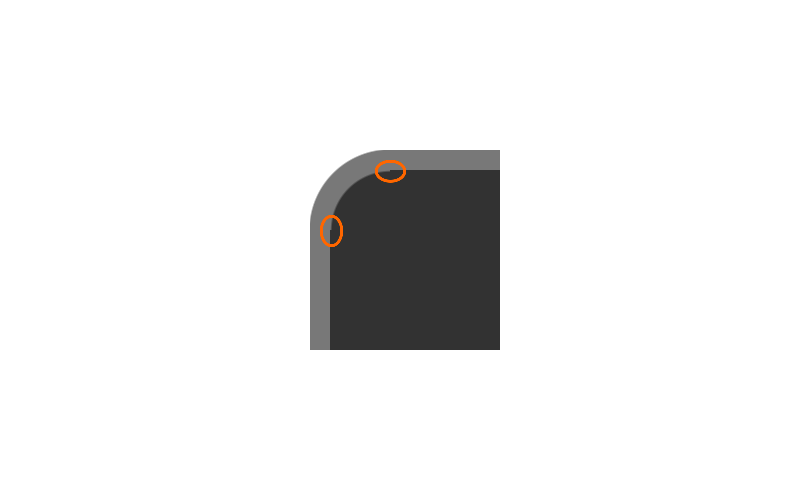
Since they appear to exist so tiny, we tin easily patch them by going back to the torso backgrounds and slightly altering the slope stops as long as everything still looks correct when changing the font size back to 10px.
.iphone { background: /* body */ linear-slope($lg 0.5em, $dg 0.55em, $dg 39.5em, $lg 39.55em) 2.25em 0 / fifteen.75em 40em, linear-gradient(90deg, $lg 0.5em, $dg 0.55em, $dg 19.175em, $lg 19.25em) 0.25em 2em / 19.75em 36em; ... } So in i linear slope, we'll add the lock switch and volume buttons to fill the 0.25em space on the left. If a 1px infinite is going to happen between the buttons and body, we can add a tiny drain of 0.05em to the background width (making it 0.3em) so that it won't stick out into the dark gray.
.iphone { background: /* volume buttons */ linear-gradient($lgT 5em, $lg 5em, $lg 7.5em, $lgT vii.5em, $lgT nine.5em, $lg 9.5em, $lg 11em, $lgT 11em, $lgT 13em, $lg 13em, $lg fourteen.5em, $lgT 14.5em) 0 0 / 0.3em 100%, ... } 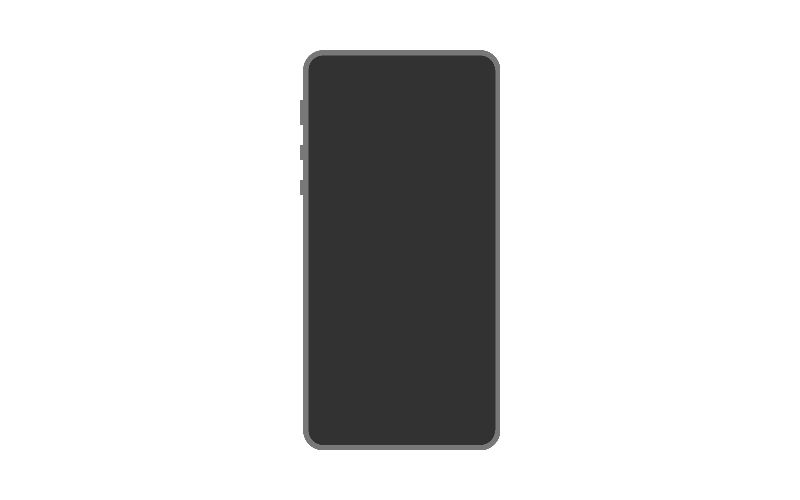
Information technology looks similar we could've used three low-cal gray-to-low-cal gray gradients, just since it was possible, only one was needed. It's simply lots of sudden transitions betwixt the transparent and opaque light grays running downwards.
Next, permit's add the edge of the dwelling push as well as the flat edges of the square inside it. Now the square inside dwelling house push button will exist 1.5 × 1.5em and follow basically the same procedure as the body: ii intersecting linear gradients and radials to fill the corners. To place them horizontally in the middle, calc() comes in handy. 50% + 0.125em will be the expression; if we centered only the phone torso, at that place will be 0.125em spaces on each side. Therefore, we move it 0.125em more to the right. The same x-positioning will employ to the upper two backgrounds.
.iphone { background: /* domicile button */ linear-slope() calc(fifty% + 0.125em) 36.5em / 0.5em one.5em, linear-gradient() calc(l% + 0.125em) 37em / 1.5em 0.5em, radial-slope(3em 3em at calc(l% + 0.125em) 37.25em, $bkT 1.25em, $bk 1.3em, $bk 49%, $bkT 50%), ... } Similar to how we shaded the linear slope parts of the phone trunk, the stops will begin and end with light gray merely with transparent in the middle. Detect we left 0.05em gaps between each gray-to-transparent transition (and vice versa). Only like the corners of the body, this is to ensure the blend betwixt a circular corner and flat end within.
.iphone { groundwork: /* home push */ linear-gradient($lg 0.15em, $lgT 0.2em, $lgT 1.35em, $lg 1.35em) calc(l% + 0.125em) 36.5em / 0.5em one.5em, linear-gradient(90deg, $lg 0.15em, $lgT 0.2em, $lgT i.3em, $lg ane.35em) calc(50% + 0.125em) 37em / 1.5em 0.5em, radial-gradient(3em 3em at calc(fifty% + 0.125em) 37.25em, $bkT 1.25em, $bk one.3em, $bk 49%, $bkT 50%), ... } 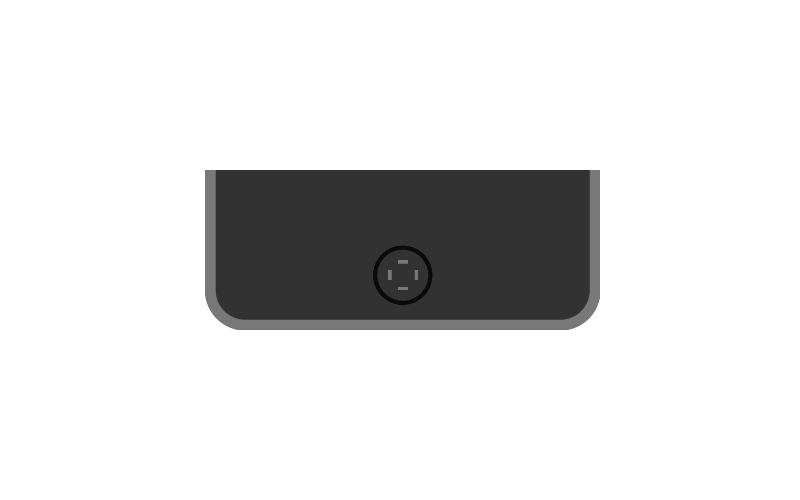
By the way, because the outlines will be then modest as you've seen earlier, we can meliorate run across what we're doing by increasing the font size to at least 20px. It's like using the zoom tool in prototype editing software.
Now to get the corners of the greyness foursquare to exactly where they should exist, let's focus on the 10-position first. We start with calc(fifty% + 0.125em), and then we add or subtract the width of each piece, or should I say the square's border radius. These backgrounds volition go higher up the final three.
.iphone { background: /* home button */ radial-slope(200% 200% at 100% 100%, $lgT 0.3em, $lg 0.35em, $lg 0.48em, $lgT 0.5em) calc(50% + 0.125em - 0.5em) 36.5em / 0.5em 0.5em, radial-gradient(200% 200% at 0% 100%, $lgT 0.3em, $lg 0.35em, $lg 0.48em, $lgT 0.5em) calc(50% + 0.125em + 0.5em) 36.5em / 0.5em 0.5em, radial-gradient(200% 200% at 100% 0%, $lgT 0.3em, $lg 0.35em, $lg 0.48em, $lgT 0.5em) calc(50% + 0.125em - 0.5em) 37.5em / 0.5em 0.5em, radial-gradient(200% 200% at 0% 0%, $lgT 0.3em, $lg 0.35em, $lg 0.48em, $lgT 0.5em) calc(50% + 0.125em + 0.5em) 37.5em / 0.5em 0.5em, ... } 
Then the screen will be a 17.25 × 30em rectangle. Just like parts of the home button, nosotros'll horizontally center it using calc(l% + 0.125em). From the top, information technology'll be 5em.
.iphone { background: /* screen */ linear-gradient($p, $p) calc(50% + 0.125em) 5em / 17.25em 30em, ... } 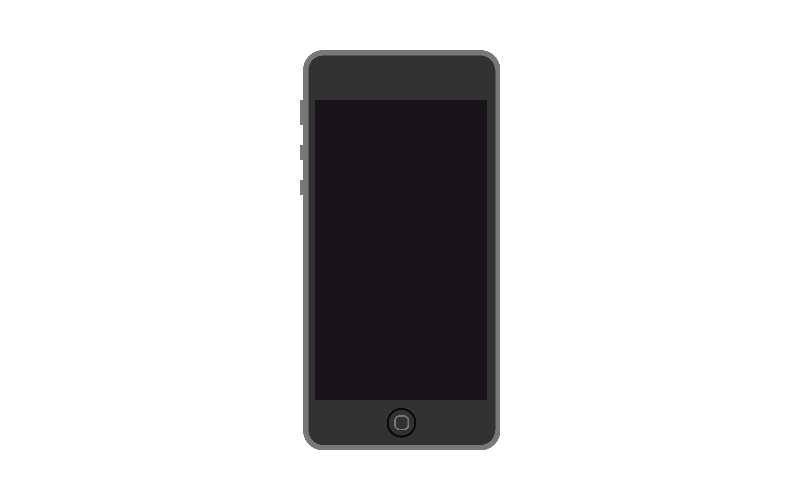
Lastly, we'll add the camera and speaker. The photographic camera is a straightforward i × i blue-to-gray radial with no fancy calculations. The pure-gray speaker though will be a bit more involved. Information technology will exist a five × 1em rectangle and take a 0.5em border radius. To draw that, we starting time depict a rectangle with the showtime 4ems of the width and heart it with calc(l% + 0.125em). And then we use 0.5 × 1em half circles in which the slope positions are 100% 50% and 0% 50%. The best mode to position these left and right of the rectangle is to utilize some new calc() expressions. For the left, we'll decrease half the rectangle width and half the half circle width from the body center (50% + 0.125em - 2em - 0.25em). The right will follow the aforementioned pattern but with addition, so fifty% + 0.125em + 2em + 0.25em.
.iphone { background: /* camera */ radial-gradient(1em 1em at 6.25em 2.5em, $bl 0.2em, $g 0.21em, $one thousand 49%, $gT fifty%), /* speaker */ radial-gradient(200% 100% at 100% fifty%, $grand 49%, $gT l%) calc(50% + 0.125em - 2em - 0.25em) 2em / 0.5em 1em, radial-gradient(200% 100% at 0% 50%, $g 49%, $gT fifty%) calc(50% + 0.125em + 2em + 0.25em) 2em / 0.5em 1em, linear-gradient($g, $yard) calc(50% + 0.125em) 2em / 4em 1em, ... } 
Remove the gray outline around the div, and the iPhone is consummate!
Come across the Pen iPhone by Jon Kantner (@jkantner) on CodePen.
Blithe Images
You might be thinking y'all could use background-position to animate these sorts of images, but you lot tin can only do so much. For case, information technology'due south impossible to animate the rotation of an private background by itself. In fact, background-position animations don't typically perform besides every bit transform animations, so I don't recommend it.
To breathing any function of an paradigm any way we wish, we can permit the :before or :subsequently pseudo-elements exist responsible for that part. If we need more selections, then we can revert to multiple child divs, however not needing 1 for each little detail. For our animated image example, we'll create this animated radar:

Nosotros describe the static part outset, which is everything except the greyness frame and rotating mitt. Before that, let'south supply our palette (note: Nosotros won't need a $dgnT for $dgn) and base of operations code.
$gn: rgb(0,192,0); $gnT: rgba(0,192,0,0); $dgn: rgb(0,48,0); $gy: rgb(128,128,128); $gyT: rgba(128,128,128,0); $bk: rgb(0,0,0); $bkT: rgba(0,0,0,0); .radar { background-echo: no-echo; font-size: 10px; outline: 1px solid #aaa; width: 20em; height: 20em; } Since this image is going to be completely round, we can safely apply a edge radius of 50%. Then, we can apply a repeating radial slope to draw the rings—about 1/3 way autonomously from each other.
.radar { background: /* rings */ repeating-radial-gradient($dgn, $dgn 2.96em, $gn 3em, $gn three.26em, $dgn 3.3em); background-echo: no-echo; border-radius: 50%; ... } 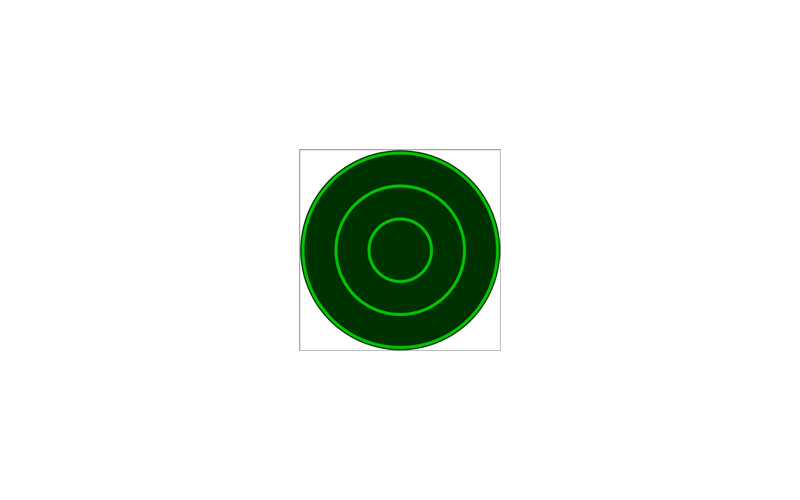
Besides note the extra $dgn at the showtime. For repeating gradients to first, end, and loop equally expected, we need to specify the starting color at 0 (or without 0).
Unlike the previous example, we're non using calc() to center the lines because Internet Explorer volition render the whole matter awkwardly when we use a pseudo-element after. To depict four 0.4em lines that intersect one other in the middle, know that half of the line should exist half the div at 10em. So then, we subtract and add half of 0.iv (0.4 / 2 = 0.2) on each side. In other words, the left of the green should exist 9.8em, and the right should exist 10.2em. For the 45deg diagonals though, we must multiply 10em by the square root of 2 to get their center (10 × √2 ≈ 14.fourteen). It's the length of the longest side of a 10em right triangle. Equally a consequence, the sides of each diagonal would be approximately at 13.94 and 14.34em.
.radar { background: /* lines */ linear-slope($gnT ix.8em, $gn ix.8em, $gn ten.2em, $gnT 10.2em), linear-gradient(45deg,$gnT xiii.94em, $gn 13.98em, $gn 14.3em, $gnT fourteen.34em), linear-gradient(90deg,$gnT 9.8em, $gn nine.8em, $gn x.2em, $gnT 10.2em), linear-slope(-45deg,$gnT thirteen.94em, $gn thirteen.98em, $gn 14.3em, $gnT 14.34em), ... } 
To prevent the pixelation of the diagonals, we left a tiny 0.04em gap between green and transparent green. Then, to create some lighting, add this transparent-to-black radial gradient:
.radar { background: /* lighting */ radial-gradient(100% 100%, $bkT, $bk 9.9em,$bkT 10em), ... } 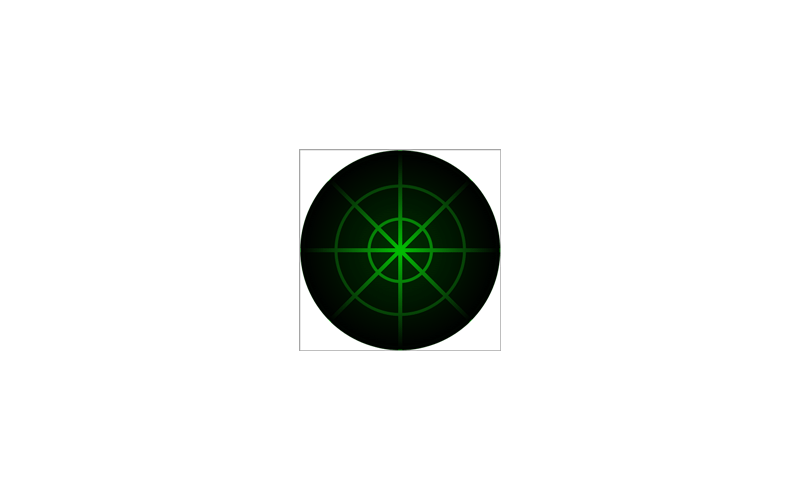
That completes the static part of the radar. Now we draw the gray frame and hand in some other background stack under :earlier and add the blitheness. There's a reason we didn't include the frame here. Because the hand container should fit the whole div, we don't desire information technology to overlap the frame.
This pseudo-element shall fill the space, and to ensure it stays in in that location, let'southward admittedly position information technology. We'll use the same border radius so that information technology stays circular while animated in Safari.
.radar { ... position: relative; &:before { background-echo: no-echo; border-radius: 50%; content: ""; position: absolute; width: 100%; top: 100%; } } Then, to draw the paw, we brand it one-half the size of its container and keep it at the meridian left corner. Finally, on pinnacle of that, we depict the frame.
.radar { ... &:before { animation: scan 5s linear infinite; groundwork: /* frame */ radial-gradient($gyT nine.20em, $gy 9.25em, $gy 10em, $gyT 10.05em), /* hand */ linear-gradient(45deg, $gnT 6em, $gn) 0 0 / 50% fifty%; ... } } @keyframes scan { from { transform: rotate(0); } to { transform: rotate(1turn); } } Now our lilliputian gadget is complete!
See the Pen Radar by Jon Kantner (@jkantner) on CodePen.
Benefits (Plus a Drawback)
This approach of drawing CSS images has several advantages. Get-go, the HTML volition be very lightweight compared to a rasterized image file. Second, it's great for tackling images that are impossible to draw well without using experimental properties and APIs that might not be widely supported.
It's non to say that this method is amend than using a parent element nested with children for the shapes. There is a drawback though. You have to give upwards being able to highlight individual shapes using the browser dev tools. You'll need to comment and uncomment a background to identify which it is. As long as yous group and label each chunk of backgrounds, yous can find that particular groundwork faster.
Conclusion
In a nutshell, the method for drawing of CSS images nosotros've covered in this mail service allows us to:
- Set a palette made up of variables for the colors.
- Disable the groundwork repeat, set a scale with
font-size, and a sheet width and superlative inemunits for the target element. - Use a temporary
outlineto show the edges as we piece of work. - Draw each shape from bottom to top because backgrounds are rendered in that order. The
groundworksyntax for each shape followsimage position / size(with or without the position and size).
At that place's a lot of thinking outside the box going on too as experimentation to get the desired result. The three examples we created were just enough to demonstrate the concept. Nosotros've looked at how nosotros social club each background, cartoon parts of circles, rounded rectangles, and slightly adjusting gradient stops for smooth edges. To learn more, experience free to dissect and written report other examples I've made in this CodePen drove!
Source: https://css-tricks.com/drawing-images-with-css-gradients/
0 Response to "Draw Half Circle Using Css"
Postar um comentário